Nikkita Lyons vs. Laynie Luck: Inside Nikkita’s First Evolve Women’s Title Defense — and the Ambush That Overshadowed It
The first defense is supposed to be the moment a new champion proves the win wasn’t a fluke. On the July 22, 2026 episode of WWE Evolve, Nikkita Lyons got that moment — and then almost immediately lost the spotlight to a chair shot she never saw coming. If you’re here for the bottom line: Nikkita Lyons pinned Laynie Luck to retain the WWE Evolve Women’s Championship, and she did it fast, in a match that barely cracked four and a half minutes. But the story of the segment isn’t the pinfall. It’s the sixty seconds after it, when PJ Vasa stormed the ring, wrapped a steel chair around Laynie Luck’s leg, and turned a routine title defense into the launch pad for an eight-woman war.
This is the full picture: what happened, why the match was so short, how Lyons even got here, what the Evolve Women’s Title actually is, and where the division goes now that Foreman Timothy Thatcher has booked a first-of-its-kind eight-woman tag to close out the night. We’ll also run down the rest of a busy 52-minute episode — Dorian Van Dux and Sam Holloway tearing the house down, Harlem Lewis holding court as the new men’s champion, and two former security guards making an emphatic in-ring debut. Consider this your complete guide to one of the more consequential Evolve episodes of the summer.
Sponsored • Adults 18+ Only
Meet Sexy New People on Your Own Schedule
Browse genuine member profiles, start a conversation when the mood strikes, and keep the pace entirely in your hands. A straightforward way to add something new to the hours after the show ends.
Availability varies by region. Free registration may be required, and some features are reserved for paying members.
Nikkita Lyons vs. Laynie Luck at a Glance
- Promotion: WWE (Evolve brand, part of the WWE ID developmental system)
- Episode: WWE Evolve — Episode 70 (listed on Tubi as Season 2, Episode 21)
- Streaming date: Wednesday, July 22, 2026
- Venue: WWE Performance Center (taped in advance)
- Location: Orlando, Florida, United States
- Main event: Nikkita Lyons (c) vs. Laynie Luck
- Stipulation: Singles match for the WWE Evolve Women’s Championship
- Championship: WWE Evolve Women’s Championship (Lyons’ first defense)
- Winner: Nikkita Lyons, by pinfall at roughly 4:30
- After the bell: PJ Vasa attacked Laynie Luck; a brawl involving Gianna Capri, Sloane Jacobs, Thea Hail, Skylar Raye and Wren Sinclair broke out, leading Thatcher to book an eight-woman tag for the following week
- How to watch: WWE Evolve streams free on Tubi in the United States and on YouTube internationally
Spoiler warning: this feature discusses the full result of the main event and the entire July 22 card in detail.
What Actually Happened
Nikkita Lyons entered as the reigning, defending Evolve Women’s Champion, flanked by her ever-present second, Sloane Jacobs. Laynie Luck came in as the challenger — a decade-deep independent veteran and, in a nice piece of cross-programming, the reigning WWE Women’s ID Champion in her own right. On paper this was champion versus champion, even if only one belt was on the line.
The match itself was a sprint. Lyons jumped Luck at the bell and never really surrendered control for long. According to the in-ring report from Pro Wrestling Dot Net’s Chris Vetter, Lyons dumped Luck into the ring steps early after Sloane Jacobs drew the challenger’s attention on the floor, then took over with a flying forearm and a series of corner hip attacks. Luck’s best moment was a slingshot double stomp to the chest for a near fall at around the three-minute mark. She went for her DVD (a spinning side-slam finisher), but Lyons wriggled free.
The finish came quickly and with a wrinkle. Lyons first tried to steal the win with a rollup while grabbing the ropes for leverage — the exact kind of cheating that had worked in an earlier match on the same show — but this time referee Derek Sanders caught her hands on the ropes and refused the count. Moments later, Luck climbed to the top rope, Lyons shook the ropes to crotch her and knock her to the mat, and then drilled her with a spinning kick to the head (billed on commentary as the “throat chakra”) for the clean three-count. Lyons retained at approximately 4:30.
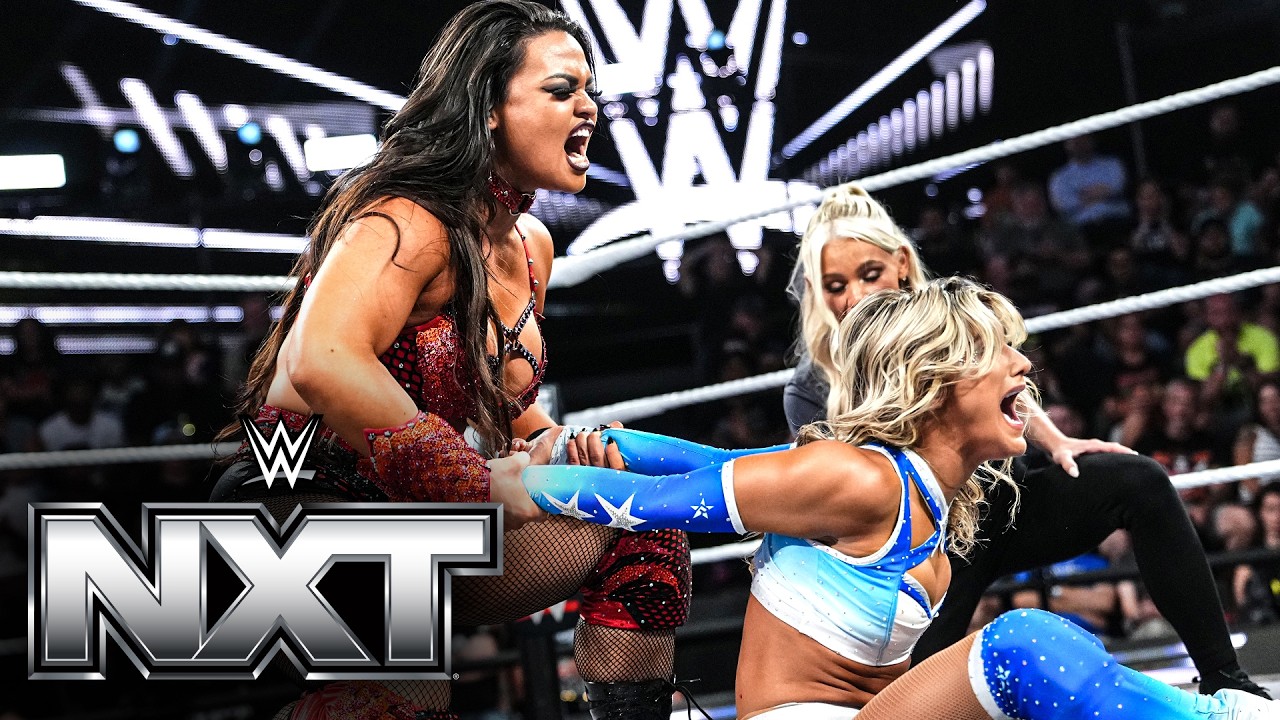
Then the real angle started. PJ Vasa — a genuinely intimidating monster heel who had not been part of the match — sprinted to the ring and flattened Luck with a Samoan drop. Gianna Capri, who’d been watching from the VIP lounge, hopped onto the apron to egg it on. Vasa grabbed a steel chair and drove it into Luck’s left leg. That brought out the cavalry: Thea Hail, Skylar Raye and Wren Sinclair charged in to run off the heels and tend to Luck. Foreman Timothy Thatcher, making his only appearance of the night, marched out and announced that next week’s Evolve would feature an eight-woman tag team match — the first of its kind on the brand.
So the headline result is simple. The lasting consequence is not. Lyons kept her title, but the segment was really about seeding a much bigger women’s-division story than a one-off title defense could ever carry.
Wait — What Is WWE Evolve, and What’s the “ID” Program?
If you’ve wandered in from the main-roster side of WWE, some quick grounding helps, because Evolve operates on a different tier than Raw, SmackDown, or even NXT. Evolve is WWE’s ground-floor developmental brand, launched in March 2025 and built around the company’s WWE ID (Independent Development) initiative. The concept: identify promising independent wrestlers, sign them to developmental deals, let them keep working the indies, and give them a televised WWE proving ground before they’re ready for the jump to NXT. Evolve airs Wednesday nights, streaming free on Tubi in the United States and on YouTube for international audiences.
The on-screen authority structure is deliberately blue-collar. The brand’s storyline boss is “Foreman” Timothy Thatcher, a respected mat technician who serves as a real-life WWE ID player/coach and doubles as Evolve’s kayfabe general manager. NXT General Manager Robert Stone floats between the two shows as a connective figure — and, notably, he was on commentary for this very episode alongside Blake Howard, with regular voice Peter Rosenberg absent. Vetter’s report flagged Stone’s presence in the booth as one of several signs that this was the third episode produced from a fresh set of tapings.
That framing matters for how you should watch a night like this. These are prospects. The “ID 1.0” class — names like Marcus Mathers, Cappuccino Jones, and Sam Holloway — are the brand’s foundational babyface group, and much of Evolve’s storytelling is built around who’s on the same page, who’s fracturing, and who’s climbing. The wrestling is often excellent; the polish and pacing are still developing. Judging an Evolve main event by main-roster standards misses the point. The point is the audition.
Where Evolve Sits in WWE’s Developmental Pyramid
To place the July 22 episode properly, it helps to understand the ladder these performers are climbing. WWE’s modern developmental structure has grown more layered than the old single-territory model. At the top of the machine sit Raw and SmackDown, the flagship weekly shows. Below them is NXT, once a purely developmental brand but now something closer to a fully realized third national brand with its own premium live events and television deal. And beneath NXT — feeding it — sits the newer ecosystem that Evolve anchors.
Evolve is the televised shop window for that ecosystem. The talent you see on a Wednesday night is, broadly, at one of two stages: signed WWE ID prospects still building toward an NXT contract, or NXT-adjacent names passing through to gain reps and screen time. Robert Stone’s repeated on-air line this episode — that “a lot of different NXT superstars” will keep appearing on Evolve, as with Dorian Van Dux — is the storyline expression of a real structural reality. The brands are porous by design. A win on Evolve can be a stepping stone; an appearance by an NXT name lends the developmental show credibility and gives the prospect a measuring stick.
This is why so much of Evolve’s booking centers on hierarchy and belonging: factions like the Mog Squad and the ID 1.0 class, authority figures like Thatcher and Stone, and championships that function as much as status markers as they do as prizes. For a viewer, the useful mental model is a talent-development conveyor belt with cameras on it. The stories are real stories, but they double as evaluations — which is exactly why a segment can prioritize launching an angle over delivering a long match.
The WWE ID Experiment, Briefly Explained
WWE ID — the Independent Development program — is one of the more interesting talent initiatives WWE has run in years, and it directly shapes what happens on Evolve. Rather than signing indie standouts to exclusive contracts and immediately pulling them behind the WWE curtain, ID lets selected wrestlers keep working the independent scene while WWE develops them, brands them as “ID prospects,” and gives them a televised outlet. The program even sanctions its own championships — the WWE ID Championship and the WWE Women’s ID Championship — which are defended on partner indie shows and give the initiative a competitive spine.
That structure is why a name like Laynie Luck can hold the WWE Women’s ID Championship, wrestle for DREAMWAVE and Glory Pro on weekends, and still main-event a WWE-branded television show against the Evolve Women’s Champion. It’s also why commentary can casually reference indie promotions on a WWE broadcast without breaking the illusion — those promotions are, in a real sense, part of the story WWE is telling. Timothy Thatcher’s dual role as a WWE ID player/coach and Evolve’s on-screen foreman is the human embodiment of the concept: a respected veteran developing the next class both in the ring and in the narrative.
For the July 22 show specifically, the ID framework adds a layer of meaning to the main event that a casual viewer might miss. Lyons versus Luck wasn’t just champion versus challenger; it was a WWE-developed prospect against a decorated independent import, the two archetypes the entire ID experiment is built to blend. That subtext is part of why the booking took care to protect Luck even in defeat. She represents a talent pipeline WWE has a vested interest in keeping credible.
The Evolve Women’s Championship: A Short, Turbulent History
The belt Lyons defended is barely more than a year old, and its lineage has already been unusually eventful. WWE crowned its first Evolve Women’s Champion on May 28, 2025, when Kali Armstrong won a Fatal Four-Way over Wendy Choo, Kendal Grey, and Kylie Rae. Grey then took the title from Armstrong to become the second champion and the brand’s breakout women’s star — so much so that WWE eventually pulled her up to NXT full-time, at which point she relinquished the Evolve belt rather than hold a title on a show she was leaving.
That vacancy set up the third reign. Wendy Choo won the vacant championship in an eight-woman gauntlet, notably last-eliminating Nikkita Lyons to do it — planting the seed for what came next. Lyons chased Choo across the spring, and at Evolve’s Succession III event she finally broke through, dropping Choo with a spinning kick to the jaw to win the title and become the fourth woman to hold it. It was, remarkably, Lyons’ first championship of any kind in WWE after nearly four years on the payroll.
One housekeeping note that seasoned Evolve watchers will appreciate: Evolve tapes weeks in advance, so the “air dates” and “reign lengths” reported around this title don’t always line up cleanly. Different outlets have listed Choo’s reign at everything from 70 to 97 days depending on whether they counted from the taping or the broadcast. It’s a reminder to treat precise day-counts on a taped developmental show with a little caution. What isn’t in dispute: Lyons is the champion, and July 22 was her first televised defense.
The Four Reigns, Reign by Reign
Laid out in order, the lineage tells a story about how quickly this division has churned through star-making moments:
- Kali Armstrong (first champion): won the inaugural title in a Fatal Four-Way on May 28, 2025, over Wendy Choo, Kendal Grey, and Kylie Rae. As the first-ever holder, Armstrong’s job was to give the belt an origin point; some records credit her with the longest actual time-holding the physical title even as WWE’s official recognition differs slightly — another quirk of a taped brand.
- Kendal Grey (second champion): the breakout. Grey took the belt from Armstrong and became the face of the women’s brand, dominant enough that WWE moved her up to NXT full-time. She vacated the Evolve title on her way out rather than hold it hostage on a show she’d left — a precedent Harlem Lewis explicitly cited in his July 22 promo.
- Wendy Choo (third champion): won the vacant title in an eight-woman gauntlet, last-eliminating Nikkita Lyons. That defeat is the seed of the current story; Lyons spent the following weeks chasing the woman who’d eliminated her, turning a gauntlet footnote into a personal quest.
- Nikkita Lyons (fourth and current champion): finally broke through at Succession III on the June 24, 2026 broadcast, dropping Choo with a spinning kick. July 22 marked her first defense.
Two patterns jump out. First, the belt has already served as a launchpad — Grey’s reign turned into an NXT call-up, exactly the trajectory the brand is designed to produce. Second, the division builds its title matches out of grudges rather than generic number-one-contender bookings: Lyons chased Choo because Choo eliminated her; Luck challenged Lyons because their camps had sabotaged each other’s big nights. That grudge-first approach is why the post-match ambush on July 22 fits so naturally. On this brand, championships are personal, and the belt is as much a story device as a prize.
Nikkita Lyons: The Long Road to a First Defense
To understand why this defense carried weight beyond its runtime, you have to understand how much road Nikkita Lyons has traveled to stand in that ring holding a belt. Lyons (real name Faith Jefferies) arrived in WWE as one of the most physically gifted prospects the company had signed in years — a taekwondo black belt with an MMA and boxing base, a background performing in the independent Women of Wrestling promotion as “Faith the Lioness,” and the kind of presence that made her feel main-roster-ready almost immediately. She debuted on WWE programming in late 2021 and became a fixture on NXT television through 2022.
And then came the knees. This is the part of the Lyons story that reframes everything. She suffered an MCL injury during the 2022 NXT Women’s Breakout Tournament. Far worse, a January 2023 angle led to a torn ACL and meniscus that cost her roughly eleven months. She returned late that year — and then re-tore the same ACL in early 2024, wiping out another huge chunk of time. For a performer whose entire appeal was athletic explosiveness, back-to-back major knee reconstructions could have quietly ended a career before it started.
Instead, Lyons rebuilt. She appeared on the third season of WWE’s reality competition LFG, where Booker T’s coaching pushed her to lean less on sex appeal and more on the substance of her act, and she resurfaced on Evolve in 2025 as the “Divine Feline,” a spiritual, zen-tinged character who talks about karma, the cosmos, and “touching grass at sunrise.” The gimmick is a smart pivot: it gives a naturally charismatic athlete a distinct voice while she knocks the rust off. Winning the Evolve Women’s Title at Succession III was the payoff to a comeback measured in years, not months.
That context is why booking her first defense as a four-and-a-half-minute squash-adjacent win is a defensible choice, even if it frustrated some viewers. WWE appears to be protecting Lyons as a dominant, still-slightly-untested champion while the more layered story — the Sloane Jacobs relationship, the encircling pack of challengers — does the heavy lifting around her.
The Divine Feline: Deconstructing the Character
The “Divine Feline” persona deserves its own look, because it’s doing more work than it appears to. On the surface it’s a comedic wellness-influencer gimmick — the “Lyons den, the zen den,” the sunrise grass-touching, the talk of cosmic balance and karma and chakras. It’s the kind of very-online character that could easily curdle into pure novelty. What keeps it from doing so is the tension the show layers underneath: this serene, enlightened champion is also perfectly willing to shake a challenger off the top rope and grab the ropes for a cheap pin. The zen is a mask, and the mask keeps slipping.
That duality is smart character construction for a performer in Lyons’ specific situation. The gimmick gives her a distinctive verbal identity and a reason to talk — something she needed after years mostly spent hurt and silent — while the underlying ruthlessness lets her wrestle like the martial-arts-trained athlete she actually is. The “Big Kat Kita” nickname, the “ROAR: real ones always rise” catchphrase, the multimedia-tour self-branding: it’s all building a character who believes her own hype and expects the universe to hand her things. That entitlement is exactly what makes her a compelling heel-leaning champion and gives challengers like Laynie Luck a clear reason to want to shut her up.
It also quietly sets up the Sloane Jacobs story. A champion who preaches serenity while demanding her friend watch her back “because everybody is looking at this” is a character whose calm is conditional on winning. The moment things go wrong, the Divine Feline mask is the first thing likely to crack — and Jacobs is positioned to be standing right there when it does.
Sponsored • Adults 18+ Only
Design an AI Girlfriend Around Your Tastes
Pick the personality, the look, and the conversation style, then talk whenever it suits you. Every AI companion is a virtual character shaped entirely around the preferences you set.
AI companions are virtual characters and are not real people. Features, subscriptions, and pricing may vary by provider.
Laynie Luck: The Indie Veteran Who Deserved a Longer Match
The most striking thing about Laynie Luck on a WWE program is how much history she brings with her. Where Lyons is a WWE-developed talent finally cashing in, Luck is the opposite archetype: a hardened independent circuit lifer who earned her way onto WWE television the long way. Based out of Chicago and performing under the self-styled “Turnt Party Unicorn” persona, Luck has been wrestling since the mid-2010s and has built a résumé across a genuine map of American indies — DREAMWAVE in Illinois, Glory Pro in the St. Louis area, and numerous other Midwest promotions.
Blake Howard’s commentary leaned into that during the match, name-dropping the promotions where Luck has worked. As Vetter wryly noted in his review, hearing regional independents get name-checked on a WWE broadcast “will never NOT be surreal” — and that’s precisely the WWE ID pitch in action. Luck isn’t just a body for Lyons to beat; she’s a recognizable name to the exact hardcore audience Evolve is courting, and she carries her own gold. She won the vacant WWE Women’s ID Championship in November 2025 at Beyond Wrestling’s Wrestling Open, outlasting a five-woman field in an elimination match, and has held that title as its longest-reigning champion.
This was also Luck’s second crack at the Evolve Women’s Championship, which is the piece that gives the loss its edge. Her first opportunity came against then-champion Wendy Choo, and it was Lyons and Sloane Jacobs who interfered to break it up before she could finish the job — meaning Lyons has now personally denied Luck a title twice, first by sabotage and now by pinfall. That’s a rivalry with real fuel in it, and it’s part of why the abrupt four-and-a-half-minute finish landed as a slight disappointment even to reviewers who expected Lyons to retain. Vetter, who “didn’t expect Laynie to win,” still admitted he “thought her title match would be longer than that.”
Then PJ Vasa targeted Luck’s leg with a chair, which reframes the whole thing. A short match plus a post-match assault is a classic way to keep a challenger strong in defeat: Luck didn’t get pinned after a war of attrition, and the story now has her as a sympathetic figure with a banged-up leg and a pack of allies rushing to her aid. If WWE wants to run Lyons–Luck back down the line, they’ve left the door wide open.
The Road to the Match: Karma, Spoiled Parties, and a Nervous Second
Evolve laid the groundwork for this defense with a tidy little revenge-and-comeuppance narrative. The backstory, as pieced together from recent episodes and the show’s own framing: Luck spoiled Lyons’ championship celebration party after Lyons won the belt, and Lyons and Jacobs had earlier ruined Luck’s own title shot against Choo. In the Divine Feline’s cosmic vocabulary, that made this defense a matter of “karma” and “the universe balancing out” — a chance to give her reign, as she put it, “a proper start.”
The opening backstage vignette is worth flagging because it planted a seed that paid off by night’s end. In her “Lyons den” meditation segment, Nikkita repeatedly leaned on Sloane Jacobs to be “the eyes on the back of my head,” and Jacobs — while loyal — looked visibly uneasy about the pressure of the champion’s first defense. Vetter’s report explicitly noted that Lyons “apparently is annoyed or upset with Sloane Jacobs” by the time the match rolled around, and on commentary Robert Stone described their dynamic as Jacobs being almost “mesmerized” by Lyons and willing to “do anything Nikkita says.”
That’s not idle color. A henchperson who is either too devoted or quietly resentful is one of wrestling’s most reliable slow-burn setups. Whether Jacobs eventually cracks under Lyons’ demands or gets discarded by a champion who “doesn’t need friends,” the episode was careful to keep that thread taut. Watch it going forward; it’s the likeliest internal fault line in Lyons’ reign.
The Match, Analyzed: A Sprint That Told a Specific Story
Let’s be clear-eyed about the in-ring product. As a match, Lyons vs. Luck was not a showcase — it was a statement, and the two aren’t the same. At around four and a half minutes, there wasn’t room for the kind of extended limb work, false-finish crescendo, or momentum see-saw that a marquee title match usually delivers. What there was, though, was a clean piece of character storytelling compressed into a short runtime.
Consider the structure. Lyons controlled the bulk of it, which is exactly what you’d want from a champion the company is trying to establish as a legitimate, physically superior force. The offense she chose — a flying corner forearm, repeated corner hip attacks, a suplex — is showy and dominant rather than technical, reinforcing the “big cat toying with prey” presentation the Divine Feline gimmick invites. Luck’s counter-flurry, capped by that slingshot double stomp, existed mainly to earn the crowd’s belief for a beat and to prove the veteran belonged. It’s efficient, if unspectacular.
The single smartest bit of storytelling was the rope-assisted rollup. Earlier in the very same episode, Brooks Jensen had beaten Elijah Holyfield by grabbing the ropes for illegal leverage and getting away with it. When Lyons tried the identical shortcut and referee Derek Sanders caught her, the show was quietly rewarding attentive viewers: the same cheat, two different outcomes, on the same night. That’s the kind of internal consistency that separates thoughtful booking from filler. It also let Lyons win “clean” moments later, preserving her as a champion who can cheat but doesn’t need to.
Key Turning Points
For a short match, there were really only three hinges, and each did a job.
The ring-steps spot. Sloane Jacobs’ distraction on the floor let Lyons ram Luck into the steel steps and seize control early. This is the numbers game paying off — a reminder that Lyons rarely fights alone and that her second is an active part of her offense, not mere set dressing. It also subtly kept Jacobs “useful” on a night when her relationship with Lyons was being questioned.
Luck’s double stomp near fall. The one genuine “she might do it” beat. In a longer match this would’ve been a mid-match momentum swing; here it functioned as Luck’s entire comeback in miniature, giving the veteran a signature highlight before the finish. Its brevity is the point — Lyons was never in serious danger, which is how you protect a champion without burying a challenger.
The rope shake off the top. The decisive turn. Luck climbing up top was the challenger reaching for a finish; Lyons calmly destabilizing the ropes to send her crashing was the champion’s ring IQ winning out. The spinning head kick that followed wasn’t a desperate escape — it was a predator closing. That finish sequence, more than any single move, is the “statement” the whole match was built to make.
Breaking Down the Finish
The closing image — Lyons uncoiling that spinning kick and hooking the leg for three — is a deliberate callback to how she won the title in the first place. She dethroned Wendy Choo at Succession III with essentially the same weapon, a spinning strike to the head. Establishing a champion’s “money” finish and then landing it again in the first defense is textbook: it makes the move feel lethal and gives commentary a shorthand (“the throat chakra”) to hype every time she loads it up. Consistency of finish is one of the cheapest, most effective tools in booking, and Evolve used it correctly.
Just as important is what the finish protected. Because Lyons won via a top-rope counter and a single strike rather than by grinding Luck down, Luck never looked physically overwhelmed — she looked caught. Combine that with the post-match angle, and Luck exits the segment with her credibility intact despite the loss. From a pure booking standpoint, the finish threads the needle: Lyons gets a clean, decisive, on-brand victory, and the challenger is positioned for sympathy and a possible return rather than written off.
The fair criticism is one of proportion. A champion’s first defense is a natural spot to give the belt a big-match feel, and a sub-five-minute sprint — however well-constructed — can read as underwhelming for an occasion the show itself hyped all night as “historic.” If there’s a knock on the segment, it’s that the wrapper promised more grandeur than the four-and-a-half-minute contents delivered.
The Post-Match Ambush and the Eight-Woman Tag
Here’s where the segment earns its place as one of the night’s most important. PJ Vasa is one of Evolve’s most physically imposing women, and deploying her as a hired-gun wrecking ball — flattening Luck with a Samoan drop and then wrapping a chair around her leg — instantly elevated the stakes of the entire division. Gianna Capri’s involvement, hopping the apron from the VIP lounge to cheer it on, ties Vasa to the show’s monied heel orbit and suggests a coordinated faction rather than a lone attacker.
The save was equally telling. Thea Hail is the most established name in that rescue party — a genuinely over babyface with a real NXT track record — and pairing her with Skylar Raye and Wren Sinclair gives the babyface side of the women’s division a recognizable core to rally behind. When Thatcher emerged to book an eight-woman tag for the next episode, he wasn’t just calming chaos; he was formalizing the battle lines. On one side, the champion’s axis: Lyons, Jacobs, Vasa, and Capri. On the other, the sympathetic challengers led by Luck and Hail.
That’s a smart use of a title defense. Rather than treating the main event as a self-contained bout, Evolve used it as the ignition point for a multi-woman program that can carry weeks of television and spotlight half a dozen prospects at once. For a developmental brand whose entire mission is getting people seen, an eight-woman tag is enormously efficient — and it gives Lyons’ reign a rooting-interest structure without requiring the champion to carry twenty-minute classics she may not yet be ready for.
Meet the Eight-Woman Tag Field
The brawl effectively unveiled the cast of the next chapter, so it’s worth knowing who’s who as the battle lines harden.
Sloane Jacobs is the linchpin. As Lyons’ devoted second, she’s been at ringside for the biggest moments of the champion’s reign, including the title win over Wendy Choo. Commentary framed her as almost hypnotized by Lyons — a follower who’ll do whatever she’s told. That devotion is the story’s most obvious pressure point: the more Lyons demands and the more curtly she treats Jacobs, the more the audience is primed for an eventual break.
PJ Vasa is the muscle. A powerful, intimidating presence, she entered this story as the enforcer who did the dirty work on Luck’s leg. Her alignment with Gianna Capri — the VIP-lounge heel who’s been floating around the brand’s monied villain scene — suggests a coordinated unit rather than a random attacker. Together, Vasa and Capri give the champion’s side genuine physical threat and a scheming-money-mark flavor.
Laynie Luck anchors the babyface resistance, now with a chair-assaulted leg and a grudge. Thea Hail is the group’s biggest name and most proven commodity — an energetic, over babyface with a real NXT résumé whose presence instantly gives the good-guy side credibility and a leader. Skylar Raye and Wren Sinclair round out the rescue party as rising prospects who benefit enormously from sharing a marquee angle with Hail and Luck. For both of them, this is the kind of high-visibility slot that developmental wrestlers need to get noticed.
The genius of the setup is how many stories it services at once. It advances the Lyons–Jacobs slow burn, gives Vasa and Capri a defined role, pays off the Lyons–Luck grudge, and elevates Raye and Sinclair — all inside a single eight-woman tag. That’s the developmental machine working exactly as intended.
Sponsored • Adults 18+ Only
Looking for a Hotter Way to End the Night?
Step into an adult social platform built for easy conversation with new people who are online and ready to talk. No pressure and no script — just see where the night takes you.
Services, eligibility, registration requirements, and pricing vary. Review the provider’s terms before joining.
The Rest of the Card: A Deep, Busy 52 Minutes
Evolve packs a lot into under an hour, and the July 22 episode was no exception. The main event may have been the marquee, but the undercard did the real developmental work — advancing multiple stories and giving several prospects meaningful minutes. Here’s how the rest of the night broke down.
Shido Ash & Viktor Zanov def. Marcus Mathers & Cappuccino Jones (5:27)
The opener doubled as a debut. Shido Ash (billed from Alexandria, Egypt — bald, heavily tattooed) and Viktor Zanov (from Bad Erlach, Austria, 250 pounds, complete with a fluffy Russian-style hat) are the two “security guards” that Foreman Thatcher hired and then fired after they went off-script and left carnage in their wake at Succession III. This was their first official match as a team, and they wrestled it with a judo-based, throw-heavy style and an unnerving calm that commentary kept emphasizing. Zanov manhandled the smaller Mathers; Shido hit a release bulldog powerslam and a belly-to-belly; the pair looked cohesive and dangerous.
On the other side, the loss continues a frustrating pattern for Marcus Mathers, one of the most talented in-ring performers on the entire brand. Mathers got the hot tag and unloaded — an Ospreay-flavored hook kick, a running penalty kick on the apron, his springboard fadeaway stunner, a Blue Thunder Bomb — before the finish exposed the ongoing fracture in the ID 1.0 ranks: Mathers accidentally knocked partner Cappuccino Jones off the apron, and Shido capitalized with a German suplex for the pin. The whole thing played out under the watchful eyes of the Mog Squad, lounging in the VIP section. It’s clean, purposeful storytelling — the babyfaces keep losing because they keep failing to stay “on the same page,” a thread Evolve has been pulling for weeks. The only real gripe, echoed by reviewers, is that the ultra-gifted Mathers has now dropped match after match, and at some point the losses start to define him.
Dorian Van Dux vs. Sam Holloway — Double Count-Out (8:12)
This was the match of the night, and it’s the one to seek out. The story was elegant: Dorian Van Dux — the second-generation Belgian “DVD,” billed from Brussels at 235 pounds — tweaked his knee early and wrestled most of the bout selling a compromised leg against the towering 6-foot-8 Sam Holloway of the ID 1.0 class. The result was a genuinely tense David-and-Goliath structure layered over an injury narrative, with Van Dux repeatedly having to improvise around a leg he couldn’t fully trust.
Both men worked well above what you’d expect from developmental. Holloway, for a man his size, threw a running dropkick that had Robert Stone audibly stunned, and moved with a lightness that made the size-versus-speed framing sing. Van Dux countered his own limitations with grit — a top-rope superplex, a Thesz press, a one-legged Samoan drop, and, in the standout decision of the match, choosing not to attempt his usual shooting star press off the bad leg and instead hitting a simpler frog splash. That’s smart, character-driven psychology: the babyface adapting his high-risk arsenal to his injury rather than ignoring it for the sake of a spot. Holloway’s twisting uranage got a near fall so convincing that Vetter admitted he thought it was the finish.
The double count-out finish will annoy some viewers who dislike non-decisive endings, and that’s a legitimate reaction. But in this specific case, the draw protected two prospects the brand clearly values — neither ate a pin, and both looked like stars. When the goal is development rather than a definitive result, a well-earned draw that leaves the crowd wanting a rematch is a reasonable trade. Expect these two to run it back.
Harlem Lewis Holds Court — and the Mog Squad Crashes It
The night’s biggest promo belonged to Harlem Lewis, Evolve’s new men’s champion. Lewis captured the Evolve Championship from Aaron Rourke on the July 15 episode, countering Rourke’s Molly-Go-Round into a powerbomb and finishing with a jackhammer — a title win that grew out of the two men’s mutual respect after Lewis helped Rourke fend off the Mog Squad. His in-ring address was a strong, fiery babyface promo: he recounted being an LFG runner-up, spending three months sharpening himself in Japan, and concluding that he had to become “more violent, more dangerous, more dominant” to break through. He even name-checked the blueprint of Kendal Grey — vowing to vacate the Evolve title on his own terms when he graduates to NXT full-time. He dubbed his reign the “Harlem Violence World Tour.”
The segment turned into a heel convention. Former champ Aaron Rourke came out to congratulate Lewis and request his rematch, only for Tristan Angels — the preening English “gentleman farmer and top shagger” — to interrupt and demand his own shot, sneering “Zip it, Sparkles!” at Rourke. Max Abrams joined the fray, and what looked like a tag-match setup instead dissolved into a brawl, with Lewis surprisingly clotheslining Rourke to end any illusion of alliance. The recurring “mog” theme — internet looksmaxxing slang the faction has fully adopted as a gimmick — got a heavy workout, with the Mog Squad insisting they “mog” everyone in the ring. It’s broad, very-online character work, but it clearly establishes a crowded contender picture around Lewis’ new reign.
Brooks Jensen def. Elijah Holyfield (4:03)
Two second-generation athletes, per commentary, though from very different worlds. Elijah Holyfield is the son of boxing legend Evander Holyfield and a former NFL running back (Georgia, then the Carolina Panthers) — a genuine blue-chip athletic pedigree, billed from Atlanta. Brooks Jensen is a former NXT hand and a self-styled veteran of the group, and here he leaned fully into a crafty, rule-bending style. This was a rematch; Jensen had beaten Holyfield once before, and Holyfield came in obsessed with redemption after an unfamiliar taste of losing.
The match smartly built to a payoff around scouting. Holyfield had clearly studied the tape — he countered a move he’d been caught with last time — but Jensen ultimately out-cheated him, removing a turnbuckle pad early and, in the finish, grabbing the ropes for leverage on a rollup to steal it again. As noted above, that illegal-leverage pin is the exact spot Lyons would try and fail with hours later in the main event, making Jensen’s version the setup to a night-long callback. Holyfield loses, but the “rookie undone by a veteran’s shortcuts” framing keeps his athletic upside intact and gives the feud a natural next chapter.
The Comedy and the Vignettes
Evolve rounds out its hour with lighter texture. Kale Dixon and his unnamed executive assistant were in the middle of yet another photo shoot when the flamboyant It’s Gal barged in, stripped to what was essentially a Speedo, and proposed a joint swimsuit calendar — grossing out Dixon and his valet, who bailed while Gal insisted he “just wanted to be friends.” That comedy has a payoff: It’s Gal vs. Kale Dixon is booked for next week. Elsewhere, Tate Wilder cut a backstage promo announcing his return to Evolve to finally settle his long-running feud with Harley Riggins (tangled up with Kam Hendrix), and a cryptic vignette teased a mysterious character billed as “The Unknown” — commentary’s Rob Stone gamely admitting the whole thing felt “a little spooky” and “not my thing.” Anya Rune’s delightfully strange “power of friendship” bit — bestowing “uwu” luck on Laynie Luck backstage — added a dash of whimsy, with Zena Sterling lurking nearby.
Undercard Prospects to Know
Part of the fun of a developmental show is spotting who might matter a year from now. Several performers on this card are worth filing away.
Marcus Mathers is, by consensus among the reviewers who cover the brand, one of the most naturally gifted in-ring workers on Evolve — a Philadelphia native with a flashy, high-end arsenal (that Ospreay-flavored hook kick, the springboard fadeaway stunner, the running penalty kick). His problem is booking, not ability: he keeps losing, and always in ways tied to the “ID 1.0 can’t stay on the same page” story. That’s a deliberate arc, but it’s a risky one. If the payoff — a breakthrough, a turn, a title run — doesn’t arrive soon, a performer this talented risks being defined by his defeats. He’s the one to watch as a test of whether Evolve’s slow-burn storytelling pays off.
Sam Holloway is the prototypical big-man project done right. At 6-foot-8 and well over 300 pounds, he could easily be a lumbering novelty; instead, the brand has developed him into a genuine power-and-agility hybrid, capable of a running dropkick that stuns the announcers. Commentary went out of its way to praise his humility and work ethic, and to float him as a future Evolve Championship contender. On a roster full of flashier acts, Holloway is the kind of foundational piece a developmental system loves: reliable, improving, and marketable.
Dorian Van Dux is the brand’s designated daredevil. The second-generation Belgian, billed as “must-see TV,” works a high-risk style built around aerial offense and a willingness to throw his body around. His July 22 match with Holloway was arguably the best pure wrestling on the show, and his cross-brand appearances on NXT and beyond mark him as someone WWE is actively developing across multiple platforms. If Evolve has a breakout in-ring star waiting to happen, DVD is a leading candidate.
Elijah Holyfield carries the most famous name and the most intriguing athletic backstory. The son of boxing legend Evander Holyfield and a former NFL running back, he’s a comparatively raw wrestler with an enormous physical ceiling — exactly the kind of elite athlete WWE loves to develop from scratch. His loss to Brooks Jensen was a “learning experience” story: the gifted newcomer out-thought by a crafty veteran. How quickly he rounds out the wrestling craft to match the athletic gifts is his arc to write.
Brooks Jensen, for his part, is playing the role of grizzled operator despite still being a young man himself. A former NXT hand now reinvented on Evolve as a rule-bending veteran, he’s carved out a useful niche: the guy who beats prospects by out-thinking and out-cheating them, teaching them (and the audience) lessons in the process. It’s not a flashy role, but it’s a valuable one on a roster that needs credible gatekeepers.
Booking Analysis: Why So Short?
The obvious question hanging over the main event is why WWE gave a first-ever title defense barely four and a half minutes. A few interpretations are worth laying out, clearly labeled as analysis rather than reported fact.
One possibility is protection through brevity. If the plan is to keep Lyons looking dominant while she continues rebuilding her in-ring conditioning after multiple long layoffs, a short, decisive win accomplishes that better than a grueling twenty-minute match that might expose ring rust. A champion who dispatches a respected veteran quickly reads as a threat; a champion who barely survives one does not.
A second, more structural read: the segment was never designed to be “the match.” Everything about the booking — the pre-match tension with Jacobs, the interference, the post-match ambush, the immediate eight-woman tag announcement — signals that the pinfall was a device to launch a larger story. In that framing, spending fifteen minutes on the wrestling would have buried the angle that actually mattered. The match was the fuse; the brawl was the bomb.
A third factor is simply the Evolve format. This is a 52-minute show that ran four matches plus multiple promos and vignettes. Time is scarce, and the brand consistently prioritizes breadth — get as many prospects on screen as possible — over long individual bouts. Within that reality, a compact main event is a feature, not a bug. None of this fully neutralizes the criticism that the occasion deserved more grandeur, but it explains the choice.
Critical and Audience Response
Early reviews of the episode were measured and consistent. Chris Vetter of Pro Wrestling Dot Net singled out Holloway vs. Van Dux as “the one to check out” of the four matches and was “totally fine with the draw” given how much he valued both men. On the main event, he was candid: he didn’t expect Luck to win, but he “thought her title match would be longer than that,” and he flagged the finish as “shockingly short.” He also voiced the recurring frustration that the “ultra-talented” Marcus Mathers keeps losing on the brand. Fightful’s Jeremy Lambert filed a straight results recap, underscoring the ambush and the eight-woman tag as the segment’s real news.
Those reactions track with the segment’s design. When the most experienced reviewers converge on “the wrestling was fine and short, but the angle was the point,” it’s usually a sign the booking communicated its priorities clearly — even to viewers who’d have preferred a longer match. It’s worth stressing that these are individual critics’ assessments, not a referendum; treat star ratings and one-line verdicts on developmental television as informed opinion rather than objective grade.
Commentary and Production Notes
The broadcast itself is worth a paragraph or two, because on a developmental show the announce team is doing real work — teaching a new audience who everyone is. This episode paired Blake Howard with Robert Stone, with regular voice Peter Rosenberg absent. That’s not a trivial swap. Stone, in his on-screen role as NXT General Manager, brings an authority-figure flavor to the booth and a built-in reason to talk up the connective tissue between Evolve and NXT. His running theme all night — that NXT stars will keep filtering through Evolve, that he has “history” with Dorian Van Dux’s family, that he’s “brokered deals” with Thatcher — is commentary as world-building, constantly reinforcing the pipeline concept.
Howard handled the play-by-play and the heavy lifting of getting names, hometowns, and backstories across, from Viktor Zanov’s Austrian roots to the litany of independent promotions on Laynie Luck’s résumé. That last touch is a signature of Evolve’s presentation: rather than pretending its imports arrived from nowhere, the show name-drops their indie history as a selling point. It’s a deliberate wink to the hardcore audience the brand is courting, and it’s part of why Evolve feels distinct from the glossier main-roster product. Vetter’s note that this appeared to be the third episode from a fresh taping cycle — with Stone in the booth and “some other personnel changes” — is a useful reminder that the show’s presentation is still evolving in real time.
On the production side, Evolve keeps things lean. The VIP lounge staging — used here for the Mog Squad and later for Gianna Capri — is an economical way to keep heels visible and involved without cramming them into every segment, and it paid off directly when Capri sprang from that lounge to abet the post-match attack. It’s a small touch, but it shows a brand thinking about how its set can serve storytelling rather than just fill space.
The Men’s Title Scene and the Mog Squad Problem
Although the women’s story headlined, the episode spent real capital building the men’s championship picture, and it’s worth pulling that thread together. Harlem Lewis is a fresh, fiery champion with a clear arc — the LFG runner-up who reinvented himself as a violent, dominant force and is openly planning his own NXT graduation. The problem, from his character’s perspective, is that everyone wants the belt at once. In a single promo segment, Aaron Rourke (the man he beat for it), Tristan Angels, and Max Abrams all staked claims, and the whole thing collapsed into a brawl that ended with Lewis abandoning any pretense of respect and clotheslining Rourke.
The Mog Squad is the connective villainy running through all of it. As a faction, they operate as the brand’s dominant heel unit — lounging in VIP, “mogging” everyone, and inserting themselves into both the tag division (watching over the opener) and the title picture (Tristan Angels and Max Abrams gunning for Lewis). Whether that ubiquity is a strength or a liability is a fair debate. On one hand, a strong central heel faction gives a young roster a clear antagonist and a lot of built-in matches. On the other, a group that’s involved in everything risks feeling less like a threat and more like set dressing if they don’t start winning meaningful singles matches and titles. The coming weeks — with Lewis promising to take on all comers — should reveal which direction the booking intends to take them.
For Aaron Rourke specifically, this episode was a soft reset. Losing the title but immediately positioning for a rematch, then eating a cheap-shot clothesline from the new champion, keeps him in the main-event mix while subtly nudging the dynamic: the respectful handshake is over, and a more personal Lewis–Rourke rivalry may be brewing underneath the Mog Squad noise.
What the Result Means for the Division
Strip away the runtime debate and the July 22 main event accomplished three concrete things for the Evolve women’s picture. First, it legitimized Nikkita Lyons as a champion who can win clean against a decorated opponent, reinforcing her signature finish in the process. Second, it kept Laynie Luck strong and sympathetic despite the loss, preserving her as a credible future challenger and as a cross-branded champion in her own right. Third, and most importantly, it detonated a multi-woman feud that instantly gives the division shape: a clear heel axis around the champion and a clear babyface resistance around Luck and Thea Hail.
For a developmental brand, that third outcome is the jackpot. Evolve doesn’t need — and arguably can’t yet sustain — a women’s division built on long, isolated title matches. It needs stories that keep many prospects visible and give the audience people to love and hate. An eight-woman tag born out of a chaotic title-defense ambush does exactly that. If the payoff is handled well, this segment will be remembered less as “the short title match” and more as “the night the Evolve women’s division found its central conflict.”
Sponsored • Adults 18+ Only
Discover an Adult Experience Picked for You
Tap through to a social, dating, chat, or AI-powered platform matched to your device and location. The exact experience adjusts to whatever’s available where you are — no guesswork required.
The destination and available service may vary by device, region, and provider. Registration, subscriptions, or charges may apply.
Career Significance for Both Women
For Nikkita Lyons, this defense is a quiet milestone. After nearly four years defined more by rehab timelines than by wins, she now has a signature title win and a successful first defense on the board — the beginnings of an actual résumé rather than a highlight reel of what-might-have-been. It doesn’t erase the injury history, and there’s a real question of how much high-mileage wrestling her surgically repaired knees can absorb, which may itself be shaping the short-match approach. But for the first time in a long time, Lyons is being booked as a person who wins things, not just a prospect who gets hurt. That’s meaningful.
For Laynie Luck, the significance is subtler but genuine. A performer who spent a decade on the independent scene now has multiple WWE television title matches to her name and a WWE ID Championship to boot. Losing to Lyons doesn’t diminish that; if anything, being the veteran the company trusts to make its comeback-story champion look good is a role of real value. And the post-match angle recasts her as a sympathetic centerpiece of the brand’s biggest women’s story. For someone whose entire career has been about earning recognition the hard way, that’s forward motion.
Historical Comparisons
The shape of this angle isn’t new, and that’s a compliment — it’s a well-worn template because it works. The “short title defense capped by a bigger post-match beatdown” is a device WWE has used for decades to protect a champion, elevate an attacker, and pivot into a multi-competitor feud without spending a marquee match to get there. Think of the countless times a champion won cleanly only for the real story — a debuting monster, a returning rival, a faction’s statement — to unfold after the bell. The mechanics on July 22 are straight out of that playbook, adapted to a developmental roster.
The Kendal Grey parallel is the one worth watching most closely, and the show invited it directly through Harlem Lewis’ promo. Grey was Evolve’s breakout women’s champion who got called up to NXT and vacated the belt on her way out. Lyons is now the reigning champion on a brand explicitly built as a stepping stone. If her reign follows the Grey arc — dominant Evolve run, momentum, eventual NXT call-up — then this first defense is an early chapter of a promotion-to-promotion success story, not the peak of one. That’s the optimistic frame for a champion who’s waited a very long time to matter.
Promotion and Business Context
A few notes on the bigger picture around the episode. Evolve’s free-streaming model — Tubi domestically, YouTube internationally — is central to its purpose. WWE isn’t monetizing Evolve primarily through this show; it’s using an ad-supported, no-friction platform to build audience familiarity with prospects before they reach the paid NXT and premium-live-event ecosystem. That’s why the show leans into breadth and recognizable indie names like Laynie Luck: the goal is reach and development, not gate revenue.
The episode also functioned as a promotional vehicle for WWE’s late-summer slate, running ads for the AAA Lucha Libre and NXT Heatwave doubleheader advertised for Edinburg, Texas on August 30, and for Sunday Night’s Main Event in Atlanta over Labor Day weekend on September 6. Those spots underline how WWE now positions Evolve and its developmental system within a connected pipeline that runs up through NXT, AAA, and the main roster — the same pipeline the show keeps telling us prospects like Harlem Lewis and Dorian Van Dux are climbing. Treat specific event details as advertised plans rather than guaranteed outcomes, since cards and dates on any promotion can shift.
What Happens Next
The immediate future is already set. Thatcher’s announcement means next week’s Evolve will feature that first-ever eight-woman tag team match, drawing the battle lines the ambush established. Expect some configuration of the champion’s camp — Lyons, Sloane Jacobs, PJ Vasa, Gianna Capri — against the babyface resistance of Laynie Luck, Thea Hail, Skylar Raye, and Wren Sinclair. Also confirmed for next week: It’s Gal vs. Kale Dixon, born from the swimsuit-calendar comedy, and the return of Tate Wilder to face Harley Riggins in a bid to end their feud.
The threads to watch beyond next week: whether Sloane Jacobs’ uneasy loyalty finally fractures; whether Harlem Lewis’ “Violence World Tour” runs through Aaron Rourke, Tristan Angels, and the rest of the Mog Squad’s crowded contender line; whether the debuting Shido Ash and Viktor Zanov keep steamrolling the ID 1.0 babyfaces; and whether Marcus Mathers’ losing streak is building to a breakthrough or a heel turn. And, of course, whoever “The Unknown” turns out to be. Evolve has laid a lot of track; the next few weeks are about which trains actually run.
What Could Happen Next: Evidence-Based Predictions
Clearly labeled as speculation rather than reporting: the most logical medium-term destination for the women’s story is a rematch or a multi-woman title match built off the eight-woman tag, with Laynie Luck’s chair-assaulted leg providing an easy hook for a more personal, longer Lyons–Luck sequel than the four-minute sprint we got. The Sloane Jacobs subplot points toward an eventual betrayal — either Jacobs turning on a demanding Lyons, or Lyons discarding Jacobs the way she flippantly suggested champions “don’t need friends.” On the men’s side, an Aaron Rourke rematch for Harlem Lewis feels inevitable, with the Mog Squad as the wild card that prevents any clean one-on-one resolution. None of this is confirmed; it’s the direction the booking appears to be pointing.
Fact Check: Storyline vs. Reality
Because this episode leaned heavily on injury drama, it’s worth drawing a clear line for readers who are newer to how wrestling works. Two “injuries” featured prominently on July 22: Dorian Van Dux selling a compromised knee throughout his match with Sam Holloway, and PJ Vasa wrapping a chair around Laynie Luck’s leg after the main event. Both are storyline elements — kayfabe, in wrestling parlance — designed to generate drama and set up future matches. Neither has been reported as a legitimate medical injury, and nothing here should be read as a real health update on either performer. Van Dux’s limp was a piece of in-match psychology; the chair spot was an angle to make Luck a sympathetic figure heading into the eight-woman tag.
That distinction matters because Nikkita Lyons’ backstory involves very real, documented injuries — the MCL tear and the two ACL surgeries that cost her years of her career. Those were reported at the time through her own statements and mainstream wrestling coverage, and they’re the genuine article. Conflating a wrestler’s real medical history with the injuries their characters “suffer” on television is an easy mistake, and a responsible reading keeps them separate. When in doubt, the rule of thumb is simple: an in-ring or post-match “injury” that advances a story is almost always a work; a real injury is confirmed through official statements or credible reporting, not through what a character sells in the ring.
Related Matches and Segments Worth Watching
If this episode hooked you, a handful of connected viewings will deepen the story:
- Nikkita Lyons vs. Wendy Choo, Evolve Succession III (June 24, 2026): the title change that started this reign, and the origin of Lyons’ spinning-kick finish. Essential context for everything above.
- Harlem Lewis vs. Aaron Rourke, Evolve (July 15, 2026): the men’s title change referenced throughout this episode, and the setup for the crowded contender picture around Lewis.
- Mog Squad vs. Marcus Mathers, Cappuccino Jones & Sam Holloway, Evolve elimination match (July 1, 2026): the six-man that established the ID 1.0-versus-Mog Squad rivalry and Holloway’s toughness.
- Any recent Dorian Van Dux singles match: if the double count-out left you wanting more, DVD’s high-risk, must-see-TV style is one of the brand’s best in-ring draws.
For more context on the brand and its stars, see our related coverage of complete WWE Evolve results, the history of the Evolve Women’s Championship, and more matches featuring Nikkita Lyons.
Frequently Asked Questions
Who won Nikkita Lyons vs. Laynie Luck?
Nikkita Lyons won, retaining the WWE Evolve Women’s Championship. She pinned Laynie Luck after a spinning kick to the head at roughly the four-and-a-half-minute mark.
Did the Evolve Women’s Championship change hands?
No. This was Lyons’ first defense of the title, and she retained. Laynie Luck did not win the belt.
When and where did the match take place?
It streamed on the July 22, 2026 episode of WWE Evolve (Episode 70, listed on Tubi as Season 2, Episode 21). Like all Evolve programming, it was taped in advance at the WWE Performance Center in Orlando, Florida.
Where can I watch WWE Evolve?
WWE Evolve streams free on Tubi in the United States and on YouTube internationally, airing on Wednesday nights.
Was the YouTube upload the full match or highlights?
The official Evolve channel typically posts full featured matches and segments. The main event ran only about four and a half minutes on the broadcast, so a full-match upload is genuinely short by design; highlight packages of other segments also circulate. Check the specific video’s title and runtime to confirm which you’re watching.
Why was the title match so short?
The most likely reasons, based on how the segment was built, are that WWE wanted a fast, dominant win to protect Lyons as champion, and that the pinfall existed mainly to launch the post-match angle and the eight-woman tag rather than to be a standalone epic. The Evolve format also runs a full card in about 52 minutes, leaving limited time per match.
What happened after the match?
PJ Vasa attacked Laynie Luck, hitting a Samoan drop and wrapping a steel chair around Luck’s leg while Gianna Capri encouraged it. Thea Hail, Skylar Raye, and Wren Sinclair ran out to make the save, and Foreman Timothy Thatcher announced an eight-woman tag team match for the following week.
Have Nikkita Lyons and Laynie Luck feuded before?
Yes. This was Luck’s second Evolve Women’s Title opportunity. Her first, against then-champion Wendy Choo, was broken up when Lyons and Sloane Jacobs interfered — so Lyons has now denied Luck a title twice.
Who is Laynie Luck?
Laynie Luck is a Chicago-based independent veteran known as the “Turnt Party Unicorn.” She has wrestled since the mid-2010s across promotions like DREAMWAVE and Glory Pro, and she is the reigning WWE Women’s ID Champion.
Is Nikkita Lyons still the Evolve Women’s Champion?
As of the July 22, 2026 episode, yes. She successfully defended the title against Laynie Luck and remains champion heading into the eight-woman tag storyline.
Who is PJ Vasa, and why did she attack Laynie Luck?
PJ Vasa is one of Evolve’s most physically dominant women. Her attack appeared coordinated with Gianna Capri and, by extension, the champion’s heel orbit — setting up the eight-woman tag rather than stemming from a prior one-on-one issue with Luck.
What is WWE Evolve?
Evolve is WWE’s entry-level developmental brand, launched in 2025 and tied to the WWE ID program, which signs and develops independent wrestlers before they advance to NXT. It streams free on Tubi and YouTube.
Final Thoughts
Judged purely as a match, Nikkita Lyons vs. Laynie Luck was a sprint that left money on the table — a first title defense that the show hyped like an event and then resolved in the time it takes to microwave popcorn. That’s a fair criticism, and the reviewers who wanted more weren’t wrong to want it. But judged as a segment, as a piece of a developmental brand’s larger machine, it did its job with real efficiency: it protected a comeback-story champion, kept a decorated challenger strong, honored attentive viewers with a same-night callback, and lit the fuse on the most promising women’s story Evolve has had in months.
The lasting image isn’t the pinfall. It’s PJ Vasa standing over a downed Laynie Luck with a chair, Thea Hail and company charging the ring, and Timothy Thatcher drawing the battle lines for an eight-woman war. Nikkita Lyons walked out still champion, but the division walked out with a pulse. For a show whose entire purpose is turning prospects into stars, that trade is one worth making. Keep your eyes on the back of the champion’s head — and on whether her most loyal ally is the one who eventually turns.
Sponsored • Adults 18+ Only
Ready to Start Something New This Week?
If the show left you looking for something to do once the credits roll, take a few minutes to browse profiles and see who might be worth a message tonight.
Availability and features depend on your location and provider. Registration may be required.
Last updated: July 23, 2026.
Affiliate Disclosure: This article contains advertising and may include sponsored or affiliate links. We may earn a commission when readers click or register through selected links, at no additional cost to them. Some advertised services are intended only for adults aged 18 or over.
 Tony D’Angelo Survives Naraku in an NXT Street Fight — Then Mike Santana Walks In